Short-Term Let Control Areas are becoming increasingly important for holiday let owners across Scotland, particularly in the country’s capital, Edinburgh, the Highlands and other popular tourist destinations.
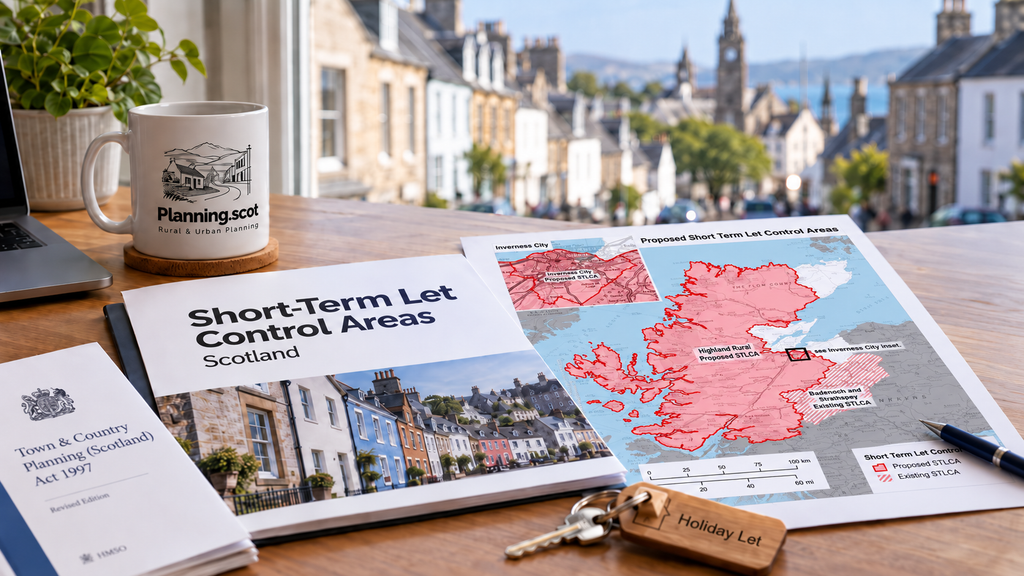
Scotland currently has two designated Short-Term Let Control Areas: one covering the entire City of Edinburgh Council area and the other covering Badenoch and Strathspey in the Highlands. Further designations are proposed across substantial parts of the Highlands and Argyll and Bute.
These changes could have significant implications for those considering short-term letting and those already operating holiday accommodation. Against that backdrop, we have prepared this short guide to explain the key principles and practical implications for property owners.
What is a Short-Term Let Control Area?
A Short-Term Let Control Area (STLCA) is an area where changing a dwellinghouse, including a flat, to a secondary short-term let is treated as a material change of use requiring planning permission.
The powers were introduced by the Planning (Scotland) Act 2019, which inserted Section 26B into the Town and Country Planning (Scotland) Act 1997, with the designation procedures set out in the Town and Country Planning (Short-term Let Control Areas) (Scotland) Regulations 2021.
Secondary letting involves letting a property which is not the owner’s principal home. The control area provisions do not generally apply to home sharing or home letting involving a person’s principal residence.
Control areas do not prohibit short-term letting. Rather, they allow planning authorities to consider the acceptability of proposed changes of use against relevant planning policies.
Why have control areas been introduced?
Short-term lets make an important contribution to Scotland’s tourism economy, supporting local businesses, employment and services, particularly in rural communities.
However, their concentration in some popular destinations has raised concerns about the availability and affordability of permanent housing, particularly for local residents and workers.
Control areas are intended to help planning authorities balance these competing considerations by bringing proposed changes from residential use to secondary short-term letting within the planning application process. This allows housing availability, residential amenity and other relevant planning matters to be considered, with opportunities for public representations.
Where are control areas already in place?
As at October 2026, Scotland has two designated Short-Term Let Control Areas:
- City of Edinburgh: Scotland’s first control area, covering the entire Council area since 5 September 2022.
- Badenoch and Strathspey: Designated by Highland Council on 4 March 2024, covering the whole of Ward 20, including Aviemore, Grantown-on-Spey, Kingussie, Newtonmore, Carrbridge and Boat of Garten.
Several further designations are under consideration, including in Highland and Argyll and Bute.
Highland Council: Two further control areas proposed
Following public consultation in May and June 2026, Highland Council’s Economy and Infrastructure Committee agreed on 28 September 2026 to submit two additional proposed control areas to Scottish Ministers for approval.
Inverness City STLCA: Covering much of Inverness, including Inverness West, Central, Ness-side and Millburn, together with parts of Inverness South, including Westhill, Milton of Leys and Slackbuie.
Highland Rural STLCA: Covering extensive rural areas, including Lochaber, Wester Ross, Strathpeffer and Lochalsh, Sutherland, Skye and Raasay, Aird and Loch Ness and parts of Inverness South, including Tomatin and Daviot.
Why is Highland Council proposing these areas?
The Council’s evidence highlights substantial concentrations of short-term lets and associated housing pressures. It reported that short-term lets accounted for more than 20% of homes in certain communities, including parts of Inverness, Portree, Dornoch and Fort William.
In Skye and Lochalsh, 13.6% of homes sold between 2019/20 and 2023/24 subsequently became short-term lets. Across the proposed Highland Rural control area, 9.5% of homes built during the preceding five years were reportedly being used as short-term lets.
The consultation attracted more than 800 responses. Among responding residents and businesses, the Council reported 84% support for the Inverness City proposal and 72% for Highland Rural. However, responses across all participant groups were more divided, particularly for Highland Rural, where opposition exceeded support overall.
Concerns were also raised about the potential effects on tourism businesses and whether the proposed controls would effectively address wider housing pressures. The Council nevertheless agreed to progress both designations.
What happens next?
Neither proposed control area is yet in force. Scottish Ministers must first consider the proposals. If approved, Highland Council must complete the formal designation process, including public notification and confirmation of a commencement date.
The Council has indicated that a further report will follow the ministerial decision, setting out the outcome and implementation arrangements.
Until the new areas take effect, the existing planning rules continue to apply.
Further information is available from Highland Council.
Cairngorms National Park: How does the control area apply?
The existing Badenoch and Strathspey control area covers a substantial part of the Cairngorms National Park, but its boundary follows Highland Council Ward 20 rather than the National Park boundary.
Consequently, properties elsewhere in the National Park, including those in Aberdeenshire, Moray, Angus and Perth and Kinross, are not automatically covered by the Badenoch and Strathspey designation.
The Cairngorms National Park Authority (CNPA) supported the designation in response to housing pressures within the National Park.
Although ordinary planning applications are generally submitted to the relevant local authority, the CNPA can call in applications raising issues of significance to the National Park’s aims.
Property owners should therefore consider both the applicable local authority control area arrangements and relevant National Park planning policies.
Argyll and Bute: Proposed control area under consultation
Argyll and Bute Council launched an eight-week consultation on 21 September 2026, proposing a Short-Term Let Control Area covering:
- Mull and Iona
- Coll and Tiree
- Islay, Jura and Colonsay
- Oban, Lorn and the Inner Isles
The consultation closes on 15 November 2026.
The proposals respond to significant local housing pressures. The Council reported that up to 42% of housing in parts of the proposed area was unavailable for permanent residential use. This figure includes housing unavailable for reasons other than short-term letting.
Unlike Highland Council’s proposals, Argyll and Bute’s designation remains at the consultation stage. No Short-Term Let Control Area is currently in force within Argyll and Bute.
Further details are available from Argyll and Bute Council.
What do control areas mean for existing short-term lets?
The designation of a control area is not retrospective. Where a property was already being used lawfully for short-term letting before designation, the new control area does not, in and of itself, require retrospective planning permission.
However, an established short-term let is not necessarily lawful simply because its use began before designation. Even outwith a control area, planning permission may have been required if the change amounted to a material change of use.
Where uncertainty exists, a Certificate of Lawfulness can formally establish the property’s lawful planning status, providing peace of mind and potentially avoiding disputes, delays and unnecessary expense in the future.
Our separate article, Certificates of Lawfulness for Short-Term Lets in the Scottish Highlands, explains this in greater detail.
Will planning permission be granted within a control area?
Designation does not mean that applications for short-term letting will automatically be refused. Each application must be determined on its merits, having regard to the development plan and other material planning considerations.
These include National Planning Framework 4 (NPF4), particularly Policy 30 on tourism, relevant local planning policies and any adopted guidance.
Depending on the circumstances, relevant considerations may include the loss of permanent housing, neighbouring amenity, parking and access arrangements and the contribution of visitor accommodation to the local economy.
Planning permission and short-term let licensing are also separate requirements. A short-term let licence does not establish that a property’s use is lawful for planning purposes, whilst planning permission or a Certificate of Lawfulness does not remove the need for an appropriate licence.
How can Planning.scot help?
Planning.scot provides professional town planning advice to existing and prospective short-term let owners throughout the Scottish Highlands and surrounding areas.
We can assess a property’s planning history and lawful use, advise on the implications of existing or proposed control areas and prepare and manage Certificates of Lawfulness or planning applications where appropriate.
For existing operators, establishing the lawful planning status of a property can be particularly valuable before a proposed control area comes into effect, providing greater certainty and helping avoid unnecessary complications and expense.
Please contact us to discuss your property’s planning status and how we can assist.
Further Reading and Resources
Scottish Government – Planning Circular 1/2023: Short-Term Lets and Planning
https://www.gov.scot/publications/short-term-lets-planning
Scottish Government – Establishing Short-Term Let Control Areas
https://www.gov.scot/publications/short-term-lets-planning/pages/3
Highland Council – Short-Term Let Control Areas
https://www.highland.gov.uk/stlcontrolarea
Highland Council – Proposed Inverness City and Highland Rural Control Areas
https://www.highland.gov.uk/stlcaconsult
Highland Council – Decision to Submit Two Further Control Areas to Scottish Ministers (28 September 2026)
https://www.highland.gov.uk/news/article/17496/highland-council-agrees-to-submit-short-term-let-control-area-proposals-to-scottish-ministers
Highland Council – Short-Term Let Planning Permission Guidance
https://www.highland.gov.uk/stlplanningpermission
Highland Council – Badenoch and Strathspey Control Area Map
https://www.highland.gov.uk/downloads/download/246/short-term-let-control-area-map
Argyll and Bute Council – Proposed Short-Term Let Control Area
https://www.argyll-bute.gov.uk/planning-and-building/planning-policy/proposed-short-term-lets-control-area