
Updated 11 October 2026
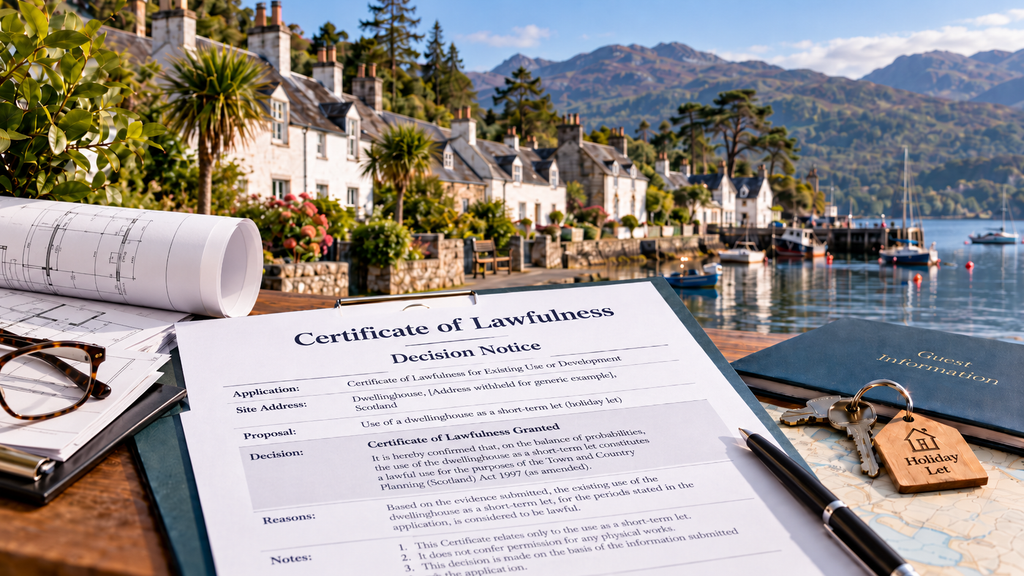
Do you own or operate a holiday let in the Highlands? Are you unsure whether planning permission is required or have you been asked to demonstrate that your short-term let is lawful?
We can review your property’s planning history, assess its eligibility for a Certificate of Lawfulness and prepare and submit the application to Highland Council on your behalf. Contact us for more information.
The planning rules surrounding short-term lets in Scotland can be complicated, particularly following the introduction of Short-Term Let Control Areas. However, not every holiday let requires planning permission and in some circumstances a Certificate of Lawfulness can provide formal confirmation that an existing or proposed use is lawful.
For existing short-term let owners, obtaining a certificate can offer valuable peace of mind, greater certainty over the property’s planning status and protection against potentially costly planning disputes in the future.
Do short-term lets require planning permission?
Whether planning permission is required depends on the circumstances of the property, its existing lawful use and whether it lies within a designated Short-Term Let Control Area.
Outwith a control area, using a dwellinghouse as a short-term let does not automatically require planning permission. The principal consideration is whether the change amounts to a material change of use.
This is assessed on a case-by-case basis, taking account of factors such as the nature and intensity of the use, guest turnover, management arrangements and potential effects on neighbouring properties.
Different rules apply within designated Short-Term Let Control Areas, where changing a dwellinghouse to secondary short-term letting is generally treated as a material change of use requiring planning permission, subject to certain exceptions.
Importantly, a property may require planning permission even if it lies outwith a control area. Equally, an existing short-term let may be lawful without having obtained planning permission.
Short-Term Let Control Areas in the Highlands
The Highlands already has an established Short-Term Let Control Area covering Badenoch and Strathspey, which came into effect on 4 March 2024.
On 28 September 2026, Highland Council agreed to submit proposals for two additional Short-Term Let Control Areas to Scottish Ministers for approval:
- Inverness City Short-Term Let Control Area, covering Inverness and surrounding areas.
- Highland Rural Short-Term Let Control Area, encompassing substantial parts of the Highlands, including Aird and Loch Ness, parts of Inverness South, Wester Ross, Strathpeffer and Lochalsh, Lochaber, Skye and Raasay and Sutherland.
The Council’s proposals have progressed through consultation and committee consideration, but Scottish Ministers’ approval is still required. If approved, further steps will be necessary to formally designate the areas and bring them into effect.
The designation of a control area is not retrospective. This means that an existing short-term let which was already operating lawfully before designation does not automatically require planning permission simply because the property subsequently falls within a control area.
However, the important distinction is whether the use was lawful in the first place. An existing short-term let may already have required planning permission if its use involved a material change from the property’s previous lawful use.
What is a Certificate of Lawfulness?
A Certificate of Lawfulness of Use or Development (CLUD) is a formal determination by the planning authority confirming that a particular existing or proposed use is lawful for planning purposes.
Unlike a planning application, the Council is not deciding whether the use is acceptable against planning policies. Instead, it considers whether the use is lawful based on the relevant facts, planning legislation and supporting evidence.
For short-term lets, a certificate may be appropriate in three principal circumstances:
- Existing short-term lets where no material change of use occurred. Where the change from residential use to short-term letting did not materially change the property’s planning use, a certificate can formally establish that planning permission was not required.
- Established short-term lets operating for more than ten years. Where a material change of use occurred without planning permission, the use may have become lawful through the passage of time, provided the relevant statutory requirements are satisfied, including demonstrating the necessary continuity of use.
- Proposed short-term lets. Where an owner intends to begin short-term letting outwith a designated control area, a certificate can be sought to establish whether the proposed use would amount to a material change of use requiring planning permission.
For existing uses, applications are made under Section 150 of the Town and Country Planning (Scotland) Act 1997. Applications concerning proposed uses are made under Section 151.
Once granted, a certificate conclusively establishes the lawfulness of the use described in it, subject to the statutory provisions governing certificates and the use remaining within its specified scope.
Should existing short-term let owners act now?
With further Short-Term Let Control Areas proposed across the Highlands, existing operators may wish to establish the lawful planning status of their properties before the new designations take effect.
Where a short-term let is already operating lawfully, the subsequent designation of a control area does not, in and of itself, mean that planning permission becomes necessary. However, obtaining a Certificate of Lawfulness provides formal confirmation of the property’s lawful planning status, offering owners valuable peace of mind and greater certainty for the future.
A certificate can help safeguard the property’s established use, removing uncertainty over its planning status and potentially avoiding disputes, delays and unnecessary expense further down the line. This can be particularly valuable when selling a property, dealing with licensing enquiries or responding to questions from the planning authority.
Highland Council’s published guidance also recognises the role of Certificates of Lawfulness in establishing the planning status of existing short-term lets. This is particularly relevant where an owner has not previously obtained formal confirmation that the use is lawful.
Although there is no general requirement to obtain a Certificate of Lawfulness before a new control area comes into effect, securing one now may be a worthwhile investment, providing lasting reassurance and helping protect the property’s value and future use.
What evidence is required?
The evidence needed to support a Certificate of Lawfulness application depends on the circumstances of the property and the grounds upon which the certificate is sought.
For existing short-term lets, this might include booking records, historic advertisements, business accounts, guest receipts, correspondence, photographs and other documentation demonstrating when the use began and how it has operated.
Where an application relies on more than ten years’ established use, demonstrating the necessary continuity and consistency of use throughout that period is particularly important.
Where the case rests on there having been no material change of use, the evidence should instead address the nature of the use and the circumstances surrounding its commencement and operation.
Applications are determined on the balance of probabilities, with responsibility resting on the applicant to provide sufficient evidence. A carefully prepared application supported by a clear and coherent account of the property’s history and use can therefore make a considerable difference.
What if a Certificate of Lawfulness is not appropriate?
Where the available evidence is insufficient to establish lawfulness, or the existing or proposed use requires planning permission, a planning application may be the appropriate alternative.
Unlike a Certificate of Lawfulness, a planning application is assessed against the development plan, including National Planning Framework 4 (NPF4), relevant local planning policies and other material planning considerations.
Relevant issues may include the loss of residential accommodation, potential economic benefits, effects on neighbouring amenity, parking and access arrangements, traffic and waste management.
Different planning considerations may also apply to holiday lodges, cabins, pods and other forms of tourist accommodation, particularly where new buildings or changes to the use of land are involved.
How can Planning.scot help?
Planning.scot provides independent, professional town planning advice and application services to short-term let owners throughout the Scottish Highlands, including Inverness, Ross-shire, Badenoch and Strathspey and the wider Highland area.
As a Chartered Town Planning consultancy, we can help establish the planning status of your property and identify the most appropriate and proportionate way forward.
Our services include:
- Initial planning assessment: Reviewing the property’s circumstances, planning history and relevant control area designation to advise whether planning permission or a Certificate of Lawfulness may be required.
- Evidence gathering and assessment: Helping identify, review and organise the documentation needed to establish the property’s historical or existing use and assessing the strength of the available evidence.
- Certificate of Lawfulness applications: Preparing the supporting planning case, coordinating plans and evidence, submitting the application and corresponding with the planning authority on your behalf.
- Planning applications: Preparing and managing applications for short-term let use where planning permission is required.
- Planning enforcement advice: Assisting property owners who have been contacted by the Council concerning the planning status of their holiday accommodation.
Our approach is to establish what is actually necessary before recommending an application, helping clients avoid unnecessary costs, delays and complications wherever possible.
It is also important to remember that planning and short-term let licensing are separate regulatory requirements. Obtaining a Certificate of Lawfulness does not replace the requirement for an appropriate short-term let licence.
Need advice about your short-term let?
Whether you already operate a holiday let, are considering starting a short-term letting business or have been asked by Highland Council to confirm your property’s planning status, Planning.scot can help.
A Certificate of Lawfulness can provide valuable peace of mind, formally establish your property’s lawful planning status and help avoid uncertainty, disputes and potentially significant expense in the future.
We can review your circumstances, explain the options available and, where appropriate, prepare and manage a Certificate of Lawfulness or planning application on your behalf.
Please contact us to discuss your property and how we can help.